California expanded its move-over rule in 2026; a school-zone change waits until 2031
California’s expanded move-over requirement took effect January 1, 2026, applying to stationary vehicles, including those displaying flashing hazard lights or another warning device. A separate school-zone speed-limit reduction from 25 mph to 20 mph is scheduled to begin January 1, 2031.
Period covered: 2026-01-01; separate school-zone change in 2031
This report describes the dated record. For services available now, visit local providers.
The move-over expansion is in effect
The California DMV announced on December 26, 2025, that AB 390 would expand the “Slow Down, Move Over” requirement beginning January 1, 2026. Drivers approaching a stationary vehicle must slow down and move over; the expanded coverage includes marked highway maintenance vehicles and vehicles displaying flashing hazard lights or another warning device. [1]
For people who drive to work, the change is relevant when they encounter a stopped vehicle along the road. The DMV’s announcement describes the expanded coverage but does not address every traffic situation. Drivers still need to account for the conditions around them when responding. [1]
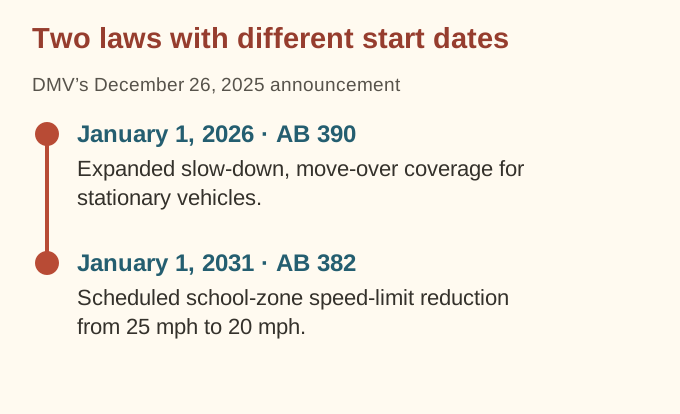
The school-zone date is five years later than the move-over expansion. These are the effective dates described in the DMV announcement; the provisions address different conduct.
LACEHH original graphic · Sources: California DMV.
A school-zone limit changes later
The same announcement says AB 382 will lower the school-zone speed limit from 25 mph to 20 mph beginning January 1, 2031. That scheduled change is separate from AB 390, which took effect at the start of 2026. [1]
The two dates matter for drivers preparing for work travel: the move-over expansion applies from 2026, while the lower school-zone limit is scheduled five years later. [1]
Rules matter beyond the knowledge test
The DMV says knowledge-test questions are based on the California Driver’s Handbook. Its preparation page also explains that first-time applicants must pass a behind-the-wheel evaluation, which assesses safe vehicle operation and applying traffic laws in real situations. Those requirements make road rules relevant both to test preparation and everyday trips; the DMV’s announcement does not specify whether either new law will appear as a test question. [2] [1]
Sources & further reading
- DMV Highlights New Laws in 2026California DMV · 2025-12-26
- California Driver’s HandbookCalifornia DMV · Undated; checked October 28, 2026
Spotted something we should look at? Suggest a correction.